
Rethinking the SDLC for the AI Era
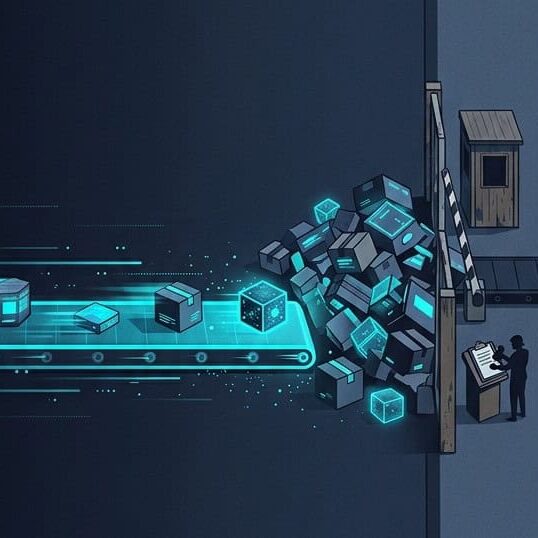
Over the past year, there’s been a steady stream of reports saying companies aren’t getting their ROI from AI. But I’d argue that most companies writing their own software have seen some lift in their development department. Nearly every engineer I know has come around to letting AI write their code, to varying degrees. And I’m willing to bet a lot of teams are already seeing benefits like these:
- Your development team is churning out work at a slightly higher rate.
- Code reviews are more thorough.
- The team doesn’t get stuck on tricky problems or unfamiliar technologies.
- PRs come with detailed, high-quality descriptions, and applications have real documentation.
- The defect rate in production may even have noticeably fallen.
That’s a win. But there’s a good chance enough is going on around it that you aren’t feeling the benefit as much as you should.
The bottleneck has moved
Development got faster, but the work around development didn’t. Requirements still take too long to gather and sign off on. A feature that once took two weeks to build and one week to define now takes a few days to build and still takes a week to define.
The overall delivery time barely moves, so the gains get absorbed before anyone outside engineering notices them.
We finally have new problems
It’s time to start addressing the new problems in software. Most software engineers spend their careers watching the same problems repeat: company to company, team to team, the same arguments about estimates, scope and tech debt.
The AI era is different. Here’s what I’m seeing.
There is an abundance of documentation, but no one reads it
The previous burden of taking the time to document everything you work on has been removed. The new problem is that it’s so verbose and technical that nobody reads it. More words didn’t make anything clearer. Documentation is only useful when the right person can find the right answer quickly.
Your SDLC still lives in a pre-AI world
Most software development life cycles were designed around one assumption: development is the longest task. Planning, design, review and release were all sized around that.
Good process became so important because rework was expensive; in the waterfall days, a late change could cost many times what an early one did. That’s just not the case anymore. Shorter cycles mean we learn about changes sooner, and AI allows us to make them faster.
Your team is probably still built with roles that match the old bandwidth: plenty of builders, and not enough capacity for requirements, testing and release when those become the new bottlenecks.
AI is another place for context to get lost
Handing work to AI creates a new line of communication. Like every handoff, it’s a place where context gets lost.
Most teams also aren’t handing off everything they could. They use AI for pieces of the work but keep the surrounding process manual. Instead of accelerating the process, AI becomes one more link in the chain.
Some tools still need a human in the middle
Many teams have tools that need manual intervention midway through the SDLC: a deployment portal, a ticketing workflow, a legacy system with no API. These are hard to automate, so the work stalls there.
What will it take to solve these?
Remove prior bias
Every process you built before AI should be challenged. If you’re still asking your team to follow the same steps you followed three years ago, you’re living in the past and not set up for the efficiencies AI can bring.
There is no more “supposed to.” The way we were supposed to gather requirements, review code or hand off to QA was designed for a world that no longer exists. Keep what still earns its place and drop the rest.
Engineer the Process, Not Just the Product
Some people on your team should be wearing an industrial engineer’s hat: building things that make the SDLC itself more efficient. A larger share of their time should go to this kind of work.
You could call it tech debt, but it’s really a new kind of work. Builders should still build. What they build should shift from purely application code toward process efficiencies.
Those tricky manual tools are a good example. You can’t automate them in one step by pointing AI at them. It takes engineering and planning, and that’s a task worth giving to your engineers.
Make it easy to do the right thing
Prioritize process changes that improve quality of life: less manual work, more free time for the people doing it. Write automations that are easy to use and plug into your process seamlessly.
Look for the friction that makes an engineer want to take a shortcut, and reduce it. Steps get skipped when they’re tedious, not because people don’t care. In the AI world, that means building quality, efficient shortcuts, like AI skills, so the risky or lazy ones never get taken.
The ROI is there, if we go get it
AI has already sped up how we write software. The ROI we’re missing is stuck in the requirements, the handoffs, the manual tools and the habits we built for a slower world.
If you’re in a position to change how your team works, start by asking which steps are only there because they’re “supposed to” be. Give some of your engineers real time to work on the process, not just the product, and count it as valuable work. And when you notice steps getting skipped, treat it as feedback rather than a discipline problem. Your engineers already know where the friction is. Often the most useful thing you can do is ask them, and then give them room to fix it.